
Source-reviewed species library

Learn the species before heading out.

Explore 100 profiles covering season, habitat and field features. These profiles support learning; they do not confirm identity or food safety.

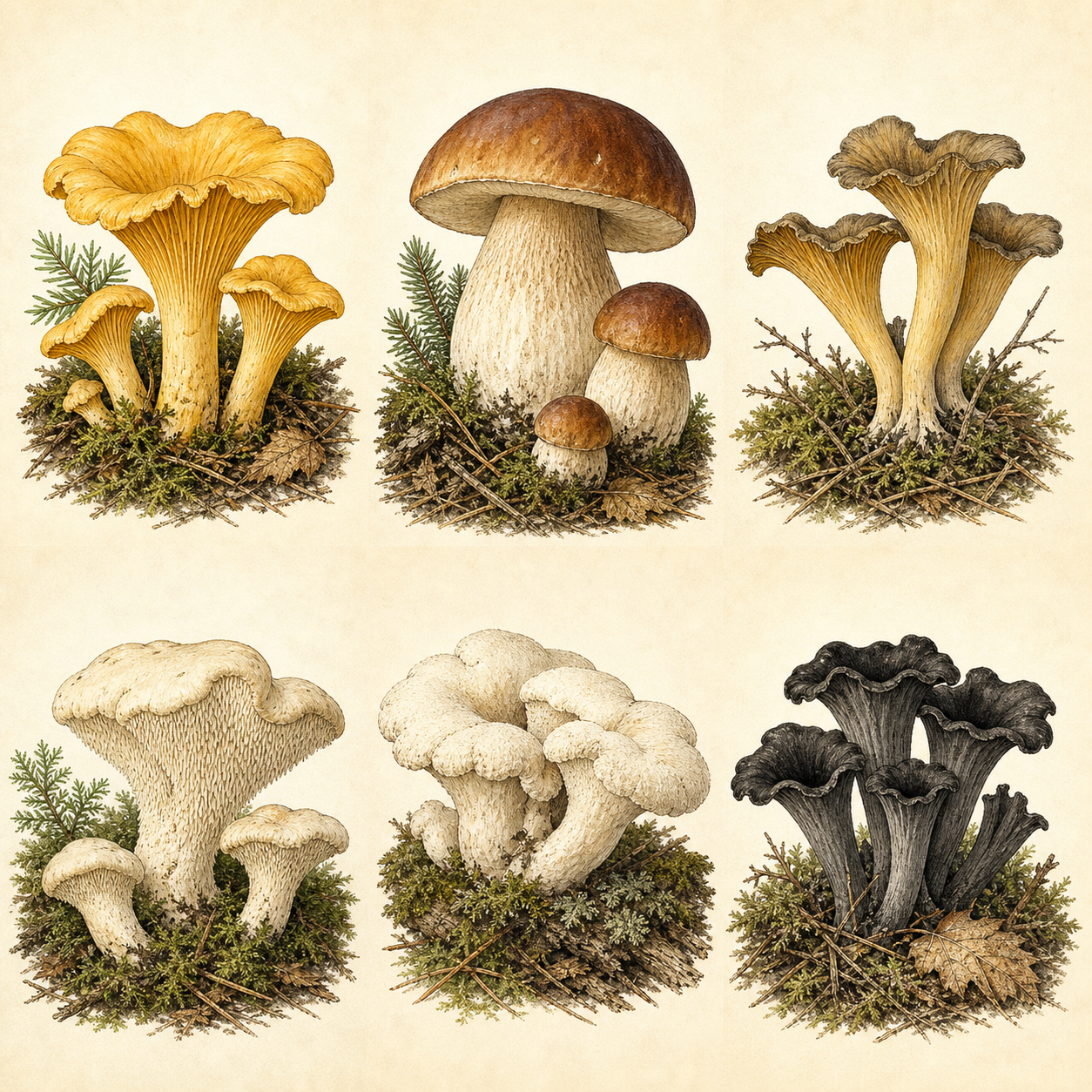
Illustrated selection of mushroom species

Source-reviewed learning profile

Bitter beech bolete Caloboletus calopus

Summer and autumn

Pale cap, yellow pores, red on the stem and an intensely bitter taste. This profile covers broad field features, season and habitat.

Where it grows
Deciduous and coniferous woodland, often on richer soil.
Look for
Pale cap, yellow pores, red on the stem and an intensely bitter taste.

Check further: Not presented as a food mushroom. This profile supports learning and safer boundaries; it does not approve a finding.

Open the full species profile →

Sources: Normlisten 2026 – Fagmykologisk råd · Norges sopp- og nyttevekstforbund – Normlistesopp · Artsdatabanken – rørsoppordenen · Giftinformasjonen – trygg sopptur. Last reviewed 9 August 2026.

Source-reviewed learning profile

Birch knight Tricholoma fulvum

Late summer and autumn

Yellow-brown gills, brown cap and yellowish flesh in the stem. This profile covers broad field features, season and habitat for learning.

Where it grows
With birch, often on acidic soil in woodland and along edges.
Look for
Yellow-brown gills, brown cap and yellowish flesh in the stem.

Check further: Included with a food status in the Norwegian 2026 Norm List. This learning profile never confirms a finding or that it is safe to eat. Use qualified local expertise.

Open the full species profile →

Sources: Normlisten 2026 – Fagmykologisk råd · Artsdatabanken – Artsnavnebasen. Last reviewed 25 August 2026.

Source-reviewed learning profile

Indian oyster Pleurotus pulmonarius

Summer and autumn

Pale fan-shaped cap with decurrent gills and a short lateral stem. This profile covers broad field features, season and habitat for learning.

Where it grows
Dead deciduous wood, especially birch, aspen and related trees.
Look for
Pale fan-shaped cap with decurrent gills and a short lateral stem.

Check further: Included with a food status in the Norwegian 2026 Norm List. This learning profile never confirms a finding or that it is safe to eat. Use qualified local expertise.

Open the full species profile →

Sources: Normlisten 2026 – Fagmykologisk råd · Artsdatabanken – Artsnavnebasen. Last reviewed 25 August 2026.

Source-reviewed learning profile

Wood hedgehog Hydnum repandum

Summer to late autumn

Pale brittle teeth beneath the cap and firm pale flesh. This profile covers broad field features, season and habitat for learning.

Where it grows
Deciduous and coniferous woodland, often in moss near beech, oak, birch or spruce.
Look for
Pale brittle teeth beneath the cap and firm pale flesh.

Check further: Included with a food status in the Norwegian 2026 Norm List. This learning profile never confirms a finding or that it is safe to eat. Use qualified local expertise.

Open the full species profile →

Sources: Normlisten 2026 – Fagmykologisk råd · Artsdatabanken – Artsnavnebasen. Last reviewed 25 August 2026.

Source-reviewed learning profile

Summer bolete Boletus reticulatus

Early summer to autumn

Dry pale-brown cap that may crack, with clear reticulation on the stem. This profile covers broad field features, season and habitat.

Where it grows
Warm deciduous woodland, especially with oak and beech.
Look for
Dry pale-brown cap that may crack, with clear reticulation on the stem.

Check further: Included with a food status in the Norwegian 2026 Norm List. This learning profile never confirms a finding or that it is safe to eat. Use qualified local expertise.

Open the full species profile →

Sources: Normlisten 2026 – Fagmykologisk råd · Norges sopp- og nyttevekstforbund – Normlistesopp · Artsdatabanken – rørsoppordenen · Giftinformasjonen – trygg sopptur. Last reviewed 9 August 2026.

Source-reviewed learning profile

Scarletina bolete Neoboletus praestigiator

Summer and autumn

Red pores, strong blue staining and a dotted stem without reticulation. This profile covers broad field features, season and habitat.

Where it grows
Deciduous and coniferous woodland, often on acidic soil.
Look for
Red pores, strong blue staining and a dotted stem without reticulation.

Check further: Included with a food status in the Norwegian 2026 Norm List. This learning profile never confirms a finding or that it is safe to eat. Use qualified local expertise.

Open the full species profile →

Sources: Normlisten 2026 – Fagmykologisk råd · Norges sopp- og nyttevekstforbund – Normlistesopp · Artsdatabanken – rørsoppordenen · Giftinformasjonen – trygg sopptur. Last reviewed 9 August 2026.

Source-reviewed learning profile

Cauliflower fungus Sparassis crispa

Late summer and autumn

Large cream-yellow cluster made of many flat, frilled lobes. This profile covers broad field features, season and habitat for learning.

Where it grows
At the base of living or dead pine trees and on roots.
Look for
Large cream-yellow cluster made of many flat, frilled lobes.

Check further: Included with a food status in the Norwegian 2026 Norm List. This learning profile never confirms a finding or that it is safe to eat. Use qualified local expertise.

Open the full species profile →

Sources: Normlisten 2026 – Fagmykologisk råd · Artsdatabanken – Artsnavnebasen. Last reviewed 25 August 2026.

Source-reviewed learning profile

Wood blewit Lepista nuda

Autumn to early winter

Violet cap, gills and stem that fade with age, with a distinct aromatic smell. This profile covers broad field features, season and habitat for learning.

Where it grows
Humus-rich deciduous or coniferous woodland, parks and compost-rich ground.
Look for
Violet cap, gills and stem that fade with age, with a distinct aromatic smell.

Check further: Included with a food status in the Norwegian 2026 Norm List. This learning profile never confirms a finding or that it is safe to eat. Use qualified local expertise.

Open the full species profile →

Sources: Normlisten 2026 – Fagmykologisk råd · Artsdatabanken – Artsnavnebasen. Last reviewed 25 August 2026.

Source-reviewed learning profile

Oyster mushroom Pleurotus ostreatus

Autumn and winter, locally also during cool spring periods

Fan-shaped grey cap, decurrent gills and lateral attachment. This profile covers broad field features, season and habitat for learning.

Where it grows
Dead or weakened deciduous wood, often beech, aspen or birch.
Look for
Fan-shaped grey cap, decurrent gills and lateral attachment.

Check further: Included with a food status in the Norwegian 2026 Norm List. This learning profile never confirms a finding or that it is safe to eat. Use qualified local expertise.

Open the full species profile →

Sources: Normlisten 2026 – Fagmykologisk råd · Artsdatabanken – Artsnavnebasen. Last reviewed 25 August 2026.

Source-reviewed learning profile

Royal fly agaric Amanita regalis

Summer and autumn

Brown cap with pale patches, a ring and rings of warts around the stem base. This profile covers broad field features, season and habitat for learning.

Where it grows
Coniferous woodland, especially boreal spruce forest.
Look for
Brown cap with pale patches, a ring and rings of warts around the stem base.

Check further: Poisonous species. This profile is safety education and must not be used to approve a finding.

Open the full species profile →

Sources: Normlisten 2026 – Fagmykologisk råd · Artsdatabanken – Artsnavnebasen. Last reviewed 25 August 2026.

Source-reviewed learning profile

Birch bolete Leccinum scabrum

Summer and autumn

Pale to brown cap and dark scabers on the stem. This profile covers broad field features, season and habitat.

Where it grows
With birch in woodland, parks and edges.
Look for
Pale to brown cap and dark scabers on the stem.

Check further: Included with a food status in the Norwegian 2026 Norm List. This learning profile never confirms a finding or that it is safe to eat. Use qualified local expertise.

Open the full species profile →

Sources: Normlisten 2026 – Fagmykologisk råd · Norges sopp- og nyttevekstforbund – Normlistesopp · Artsdatabanken – rørsoppordenen · Giftinformasjonen – trygg sopptur. Last reviewed 9 August 2026.

Source-reviewed learning profile

Chaga Inonotus obliquus

Visible throughout the year

Black, charcoal-like sterile growth on the trunk rather than a typical cap-forming fruit body. This profile covers broad field features, season and habitat for learning.

Where it grows
Mainly on living birch in boreal woodland.
Look for
Black, charcoal-like sterile growth on the trunk rather than a typical cap-forming fruit body.

Check further: Not presented as a food mushroom. This profile supports learning and safer boundaries; it does not approve a finding.

Open the full species profile →

Sources: Normlisten 2026 – Fagmykologisk råd · Artsdatabanken – Artsnavnebasen. Last reviewed 25 August 2026.

Source-reviewed learning profile

Curry milkcap Lactarius camphoratus

Summer and autumn

Small red-brown milkcap with watery latex and a curry-like smell when drying. This profile covers broad field features, season and habitat for learning.

Where it grows
Moist coniferous and mixed woodland, often with spruce.
Look for
Small red-brown milkcap with watery latex and a curry-like smell when drying.

Check further: Included with a food status in the Norwegian 2026 Norm List. This learning profile never confirms a finding or that it is safe to eat. Use qualified local expertise.

Open the full species profile →

Sources: Normlisten 2026 – Fagmykologisk råd · Artsdatabanken – Artsnavnebasen. Last reviewed 25 August 2026.

Source-reviewed learning profile

Fragrant waxcap Hygrophorus agathosmus

Autumn

Grey slimy cap, thick pale gills and a distinct almond-like smell. This profile covers broad field features, season and habitat for learning.

Where it grows
Spruce woodland, often in moss on acidic soil.
Look for
Grey slimy cap, thick pale gills and a distinct almond-like smell.

Check further: Included with a food status in the Norwegian 2026 Norm List. This learning profile never confirms a finding or that it is safe to eat. Use qualified local expertise.

Open the full species profile →

Sources: Normlisten 2026 – Fagmykologisk råd · Artsdatabanken – Artsnavnebasen. Last reviewed 25 August 2026.

Source-reviewed learning profile

Cultivated mushroom Agaricus bisporus

Variable; cultivated year-round

Free gills that turn from pink to dark brown and a ring on the stem. This profile covers broad field features, season and habitat for learning.

Where it grows
Commercially cultivated; may also occur on nutrient-rich disturbed soil.
Look for
Free gills that turn from pink to dark brown and a ring on the stem.

Check further: Included with a food status in the Norwegian 2026 Norm List. This learning profile never confirms a finding or that it is safe to eat. Use qualified local expertise.

Open the full species profile →

Sources: Normlisten 2026 – Fagmykologisk råd · Artsdatabanken – Artsnavnebasen. Last reviewed 25 August 2026.

Source-reviewed learning profile

Meadow waxcap Cuphophyllus pratensis

Late summer and autumn

Waxy yellow-orange cap and thick, strongly decurrent gills. This profile covers broad field features, season and habitat for learning.

Where it grows
Old, unfertilised grassland, pasture and lawns.
Look for
Waxy yellow-orange cap and thick, strongly decurrent gills.

Check further: Included with a food status in the Norwegian 2026 Norm List. This learning profile never confirms a finding or that it is safe to eat. Use qualified local expertise.

Open the full species profile →

Sources: Normlisten 2026 – Fagmykologisk råd · Artsdatabanken – Artsnavnebasen. Last reviewed 25 August 2026.

Source-reviewed learning profile

False chanterelle Hygrophoropsis aurantiaca

Summer and autumn

Orange funnel with thin crowded forked true gills. This profile covers broad field features, season and habitat.

Where it grows
Coniferous woodland litter, stumps and woody debris.
Look for
Orange funnel with thin crowded forked true gills.

Check further: Not presented as a food mushroom. This profile supports learning and safer boundaries; it does not approve a finding.

Open the full species profile →

Sources: Normlisten 2026 – Fagmykologisk råd · Pensumliste for soppsakkyndige – traktsopper · Giftinformasjonen – sopp. Last reviewed 9 August 2026.

Source-reviewed learning profile

Northern milkcap Lactarius repraesentaneus

Summer and autumn

Yellow woolly cap; white latex turns violet where it meets the flesh. This profile covers broad field features, season and habitat for learning.

Where it grows
Moist woodland with birch or spruce, often in northern regions.
Look for
Yellow woolly cap; white latex turns violet where it meets the flesh.

Check further: Included with a food status in the Norwegian 2026 Norm List. This learning profile never confirms a finding or that it is safe to eat. Use qualified local expertise.

Open the full species profile →

Sources: Normlisten 2026 – Fagmykologisk råd · Artsdatabanken – Artsnavnebasen. Last reviewed 25 August 2026.

Source-reviewed learning profile

Funeral bell Galerina marginata

Summer to late autumn

Small brown hygrophan cap, ring zone and rusty gills; a dangerous sheathed-woodtuft lookalike. This profile covers broad field features, season and habitat for learning.

Where it grows
Dead wood, especially conifer, singly or in small groups.
Look for
Small brown hygrophan cap, ring zone and rusty gills; a dangerous sheathed-woodtuft lookalike.

Check further: Deadly poisonous species. Never treat an image or app assessment as confirmation. Use qualified expertise.

Open the full species profile →

Sources: Normlisten 2026 – Fagmykologisk råd · Artsdatabanken – Artsnavnebasen. Last reviewed 25 August 2026.

Source-reviewed learning profile

Suede bolete Xerocomus ferrugineus

Summer and autumn

Dry velvety brown cap and yellow pores. This profile covers broad field features, season and habitat.

Where it grows
Deciduous and coniferous woodland with mycorrhizal trees.
Look for
Dry velvety brown cap and yellow pores.

Check further: Included with a food status in the Norwegian 2026 Norm List. This learning profile never confirms a finding or that it is safe to eat. Use qualified local expertise.

Open the full species profile →

Sources: Normlisten 2026 – Fagmykologisk råd · Norges sopp- og nyttevekstforbund – Normlistesopp · Artsdatabanken – rørsoppordenen · Giftinformasjonen – trygg sopptur. Last reviewed 9 August 2026.

Source-reviewed learning profile

Herald of winter Hygrophorus hypothejus

Late autumn to early winter

Slimy olive-brown cap, yellow tones and thick decurrent gills. This profile covers broad field features, season and habitat for learning.

Where it grows
Pine woodland on acidic, often sandy soil.
Look for
Slimy olive-brown cap, yellow tones and thick decurrent gills.

Check further: Included with a food status in the Norwegian 2026 Norm List. This learning profile never confirms a finding or that it is safe to eat. Use qualified local expertise.

Open the full species profile →

Sources: Normlisten 2026 – Fagmykologisk råd · Artsdatabanken – Artsnavnebasen. Last reviewed 25 August 2026.

Source-reviewed learning profile

Pinecone cap Strobilurus stephanocystis

Spring

Small pale-brown cap on a thin stem arising from a buried pine cone. This profile covers broad field features, season and habitat.

Where it grows
On buried pine cones in pine woodland.
Look for
Small pale-brown cap on a thin stem arising from a buried pine cone.

Check further: Included with a food status in the Norwegian 2026 Norm List. This learning profile never confirms a finding or that it is safe to eat. Use qualified local expertise.

Open the full species profile →

Sources: Normlisten 2026 – Fagmykologisk råd · Norges sopp- og nyttevekstforbund – vinter- og vårsopper · Giftinformasjonen – sandmorkel. Last reviewed 9 August 2026.

Source-reviewed learning profile

Saffron milkcap Lactarius deliciosus

Late summer and autumn

Orange zoned cap, orange latex and green staining after damage. This profile covers broad field features, season and habitat.

Where it grows
With pine, often on sandy or lime-rich soil.
Look for
Orange zoned cap, orange latex and green staining after damage.

Check further: Included with a food status in the Norwegian 2026 Norm List. This learning profile never confirms a finding or that it is safe to eat. Use qualified local expertise.

Open the full species profile →

Sources: Normlisten 2026 – Fagmykologisk råd · Artsdatabanken – artsnavn og norske funn · Giftinformasjonen – trygg sopptur. Last reviewed 9 August 2026.

Source-reviewed learning profile

Scaly tooth Sarcodon squamosus

Late summer and autumn

Large brown cap with coarse dark scales and teeth underneath. This profile covers broad field features, season and habitat for learning.

Where it grows
Dry pine woodland on nutrient-poor soil.
Look for
Large brown cap with coarse dark scales and teeth underneath.

Check further: Included with a food status in the Norwegian 2026 Norm List. This learning profile never confirms a finding or that it is safe to eat. Use qualified local expertise.

Open the full species profile →

Sources: Normlisten 2026 – Fagmykologisk råd · Artsdatabanken – Artsnavnebasen. Last reviewed 25 August 2026.

Source-reviewed learning profile

Sheep polypore Albatrellus ovinus

Summer and autumn

Irregular pale cap, pores underneath and fruit bodies that may fuse together. This profile covers broad field features, season and habitat for learning.

Where it grows
Coniferous woodland, especially spruce forest, often growing in groups on the ground.
Look for
Irregular pale cap, pores underneath and fruit bodies that may fuse together.

Check further: Included with a food status in the Norwegian 2026 Norm List. This learning profile never confirms a finding or that it is safe to eat. Use qualified local expertise.

Open the full species profile →

Sources: Normlisten 2026 – Fagmykologisk råd · Artsdatabanken – Artsnavnebasen. Last reviewed 25 August 2026.

Source-reviewed learning profile

Bitter bolete Tylopilus felleus

Summer and autumn

Mature pores turn pink and the pale stem has coarse dark reticulation. This profile covers broad field features, season and habitat.

Where it grows
Often coniferous and mixed woodland on acidic soil.
Look for
Mature pores turn pink and the pale stem has coarse dark reticulation.

Check further: Not presented as a food mushroom. This profile supports learning and safer boundaries; it does not approve a finding.

Open the full species profile →

Sources: Normlisten 2026 – Fagmykologisk råd · Norges sopp- og nyttevekstforbund – Normlistesopp · Artsdatabanken – rørsoppordenen · Giftinformasjonen – trygg sopptur. Last reviewed 9 August 2026.

Source-reviewed learning profile

Truncate club Clavariadelphus truncatus

Late summer and autumn

Robust club with a flattened or depressed top and yellow-brown colours. This profile covers broad field features, season and habitat for learning.

Where it grows
Coniferous woodland, especially under spruce in moss and litter.
Look for
Robust club with a flattened or depressed top and yellow-brown colours.

Check further: Included with a food status in the Norwegian 2026 Norm List. This learning profile never confirms a finding or that it is safe to eat. Use qualified local expertise.

Open the full species profile →

Sources: Normlisten 2026 – Fagmykologisk råd · Artsdatabanken – Artsnavnebasen. Last reviewed 25 August 2026.

Source-reviewed learning profile

Sprucecone cap Strobilurus esculentus

Early spring

Small brown cap on a thin tough stem growing directly from a spruce cone. This profile covers broad field features, season and habitat.

Where it grows
On buried spruce cones in coniferous woodland.
Look for
Small brown cap on a thin tough stem growing directly from a spruce cone.

Check further: Included with a food status in the Norwegian 2026 Norm List. This learning profile never confirms a finding or that it is safe to eat. Use qualified local expertise.

Open the full species profile →

Sources: Normlisten 2026 – Fagmykologisk råd · Norges sopp- og nyttevekstforbund – vinter- og vårsopper · Giftinformasjonen – sandmorkel. Last reviewed 9 August 2026.

Source-reviewed learning profile

False saffron milkcap Lactarius deterrimus

Late summer and autumn

Orange zoned cap, orange latex and rapid green staining; usually with spruce. This profile covers broad field features, season and habitat.

Where it grows
With spruce, often in young plantations and moss.
Look for
Orange zoned cap, orange latex and rapid green staining; usually with spruce.

Check further: Included with a food status in the Norwegian 2026 Norm List. This learning profile never confirms a finding or that it is safe to eat. Use qualified local expertise.

Open the full species profile →

Sources: Normlisten 2026 – Fagmykologisk råd · Artsdatabanken – artsnavn og norske funn · Giftinformasjonen – trygg sopptur. Last reviewed 9 August 2026.

Source-reviewed learning profile

Shingled hedgehog Sarcodon imbricatus

Late summer and autumn

Large brown cap with overlapping scales and grey-brown teeth underneath. This profile covers broad field features, season and habitat for learning.

Where it grows
Spruce woodland, often on acidic soil.
Look for
Large brown cap with overlapping scales and grey-brown teeth underneath.

Check further: Included with a food status in the Norwegian 2026 Norm List. This learning profile never confirms a finding or that it is safe to eat. Use qualified local expertise.

Open the full species profile →

Sources: Normlisten 2026 – Fagmykologisk råd · Artsdatabanken – Artsnavnebasen. Last reviewed 25 August 2026.

Source-reviewed learning profile

Aniseed funnel Clitocybe odora

Summer and autumn

Blue-green to grey-green funnel with a strong aniseed smell. This profile covers broad field features, season and habitat for learning.

Where it grows
Deciduous and coniferous woodland in litter and humus.
Look for
Blue-green to grey-green funnel with a strong aniseed smell.

Check further: Included with a food status in the Norwegian 2026 Norm List. This learning profile never confirms a finding or that it is safe to eat. Use qualified local expertise.

Open the full species profile →

Sources: Normlisten 2026 – Fagmykologisk råd · Artsdatabanken – Artsnavnebasen. Last reviewed 25 August 2026.

Source-reviewed learning profile

Death cap Amanita phalloides

Late summer and autumn

Olive-green to yellow-green cap, white gills, ring and a clear volva at the base. This profile covers broad field features, season and habitat for learning.

Where it grows
Warm deciduous woodland and parks, especially with oak, beech or hazel.
Look for
Olive-green to yellow-green cap, white gills, ring and a clear volva at the base.

Check further: Deadly poisonous species. Never treat an image or app assessment as confirmation. Use qualified expertise.

Open the full species profile →

Sources: Normlisten 2026 – Fagmykologisk råd · Artsdatabanken – Artsnavnebasen. Last reviewed 25 August 2026.

Source-reviewed learning profile

Green brittlegill Russula aeruginea

Summer and autumn

Green to grey-green cap, brittle white gills and a white stem. This profile covers broad field features, season and habitat for learning.

Where it grows
Deciduous and mixed woodland, especially with birch.
Look for
Green to grey-green cap, brittle white gills and a white stem.

Check further: Included with a food status in the Norwegian 2026 Norm List. This learning profile never confirms a finding or that it is safe to eat. Use qualified local expertise.

Open the full species profile →

Sources: Normlisten 2026 – Fagmykologisk råd · Artsdatabanken – Artsnavnebasen. Last reviewed 25 August 2026.

Source-reviewed learning profile

Grey spotted amanita Amanita excelsa

Summer and autumn

Grey-brown cap with grey patches, striate ring and a bulbous base without a sack-like volva. This profile covers broad field features, season and habitat for learning.

Where it grows
Deciduous and coniferous woodland on varied soils.
Look for
Grey-brown cap with grey patches, striate ring and a bulbous base without a sack-like volva.

Check further: Included with a food status in the Norwegian 2026 Norm List. This learning profile never confirms a finding or that it is safe to eat. Use qualified local expertise.

Open the full species profile →

Sources: Normlisten 2026 – Fagmykologisk råd · Artsdatabanken – Artsnavnebasen. Last reviewed 25 August 2026.

Source-reviewed learning profile

Charcoal burner knight Tricholoma portentosum

Late autumn

Grey radially streaked cap, white gills with yellow tones and a mealy smell. This profile covers broad field features, season and habitat for learning.

Where it grows
Pine woodland, often on sandy acidic soil.
Look for
Grey radially streaked cap, white gills with yellow tones and a mealy smell.

Check further: Included with a food status in the Norwegian 2026 Norm List. This learning profile never confirms a finding or that it is safe to eat. Use qualified local expertise.

Open the full species profile →

Sources: Normlisten 2026 – Fagmykologisk råd · Artsdatabanken – Artsnavnebasen. Last reviewed 25 August 2026.

Source-reviewed learning profile

Yellow trumpet Craterellus lutescens

Late summer and autumn

Thin funnel, orange-yellow hollow stem and a nearly smooth underside. This profile covers broad field features, season and habitat.

Where it grows
Moist coniferous woodland, bog edges and mossy ground.
Look for
Thin funnel, orange-yellow hollow stem and a nearly smooth underside.

Check further: Included with a food status in the Norwegian 2026 Norm List. This learning profile never confirms a finding or that it is safe to eat. Use qualified local expertise.

Open the full species profile →

Sources: Normlisten 2026 – Fagmykologisk råd · Pensumliste for soppsakkyndige – traktsopper · Giftinformasjonen – sopp. Last reviewed 9 August 2026.

Source-reviewed learning profile

Trooping funnel Infundibulicybe geotropa

Autumn

Large pale funnel with a central boss and strongly decurrent gills. This profile covers broad field features, season and habitat.

Where it grows
Deciduous woodland, edges and grassy clearings, often in rings.
Look for
Large pale funnel with a central boss and strongly decurrent gills.

Check further: Included with a food status in the Norwegian 2026 Norm List. This learning profile never confirms a finding or that it is safe to eat. Use qualified local expertise.

Open the full species profile →

Sources: Normlisten 2026 – Fagmykologisk råd · Pensumliste for soppsakkyndige – traktsopper · Giftinformasjonen – sopp. Last reviewed 9 August 2026.

Source-reviewed learning profile

Honey fungus Armillaria mellea

Late summer and autumn

Honey-yellow finely scaled cap, ring and black root-like cords in the wood. This profile covers broad field features, season and habitat for learning.

Where it grows
On roots, stumps and trunks of deciduous trees, often in dense clusters.
Look for
Honey-yellow finely scaled cap, ring and black root-like cords in the wood.

Check further: Not presented as a food mushroom. This profile supports learning and safer boundaries; it does not approve a finding.

Open the full species profile →

Sources: Normlisten 2026 – Fagmykologisk råd · Artsdatabanken – Artsnavnebasen. Last reviewed 25 August 2026.

Source-reviewed learning profile

Hollow bolete Suillus cavipes

Summer and autumn

Hollow stem, dry to slightly scaly cap and large angular pores. This profile covers broad field features, season and habitat.

Where it grows
Associated with larch.
Look for
Hollow stem, dry to slightly scaly cap and large angular pores.

Check further: Included with a food status in the Norwegian 2026 Norm List. This learning profile never confirms a finding or that it is safe to eat. Use qualified local expertise.

Open the full species profile →

Sources: Normlisten 2026 – Fagmykologisk råd · Norges sopp- og nyttevekstforbund – Normlistesopp · Artsdatabanken – rørsoppordenen · Giftinformasjonen – trygg sopptur. Last reviewed 9 August 2026.

Source-reviewed learning profile

Destroying angel Amanita virosa

Summer and autumn

Entirely white mushroom with free gills, a ring and a sack-like volva at the base. This profile covers broad field features, season and habitat for learning.

Where it grows
Moist woodland, especially with spruce or birch.
Look for
Entirely white mushroom with free gills, a ring and a sack-like volva at the base.

Check further: Deadly poisonous species. Never treat an image or app assessment as confirmation. Use qualified expertise.

Open the full species profile →

Sources: Normlisten 2026 – Fagmykologisk råd · Artsdatabanken – Artsnavnebasen. Last reviewed 25 August 2026.

Source-reviewed learning profile

Lurid bolete Suillellus luridus

Summer to early autumn

Orange-red pores, reticulation on the stem and marked blue staining. This profile covers broad field features, season and habitat.

Where it grows
Often lime-rich deciduous woodland and parks with oak, lime or beech.
Look for
Orange-red pores, reticulation on the stem and marked blue staining.

Check further: Included with a food status in the Norwegian 2026 Norm List. This learning profile never confirms a finding or that it is safe to eat. Use qualified local expertise.

Open the full species profile →

Sources: Normlisten 2026 – Fagmykologisk råd · Norges sopp- og nyttevekstforbund – Normlistesopp · Artsdatabanken – rørsoppordenen · Giftinformasjonen – trygg sopptur. Last reviewed 9 August 2026.

Source-reviewed learning profile

Verdigris agaric Stropharia aeruginosa

Summer and autumn

Blue-green slimy cap with pale veil remnants and purple-brown gills. This profile covers broad field features, season and habitat for learning.

Where it grows
Humus-rich woodland, parks, wood chips and other organic material.
Look for
Blue-green slimy cap with pale veil remnants and purple-brown gills.

Check further: Included with a food status in the Norwegian 2026 Norm List. This learning profile never confirms a finding or that it is safe to eat. Use qualified local expertise.

Open the full species profile →

Sources: Normlisten 2026 – Fagmykologisk råd · Artsdatabanken – Artsnavnebasen. Last reviewed 25 August 2026.

Source-reviewed learning profile

Jelly tooth Pseudohydnum gelatinosum

Summer and autumn

Translucent greyish jelly fungus with small teeth underneath. This profile covers broad field features, season and habitat for learning.

Where it grows
On well-decayed conifer wood in moist woodland.
Look for
Translucent greyish jelly fungus with small teeth underneath.

Check further: Included with a food status in the Norwegian 2026 Norm List. This learning profile never confirms a finding or that it is safe to eat. Use qualified local expertise.

Open the full species profile →

Sources: Normlisten 2026 – Fagmykologisk råd · Artsdatabanken – Artsnavnebasen. Last reviewed 25 August 2026.

Source-reviewed learning profile

Wood ear Auricularia auricula-judae

Year-round in mild periods, most frequent from autumn to spring

Brown ear-shaped gelatinous fruit body with a finely hairy outer surface. This profile covers broad field features, season and habitat for learning.

Where it grows
Dead or weakened deciduous wood, often elder.
Look for
Brown ear-shaped gelatinous fruit body with a finely hairy outer surface.

Check further: Included with a food status in the Norwegian 2026 Norm List. This learning profile never confirms a finding or that it is safe to eat. Use qualified local expertise.

Open the full species profile →

Sources: Normlisten 2026 – Fagmykologisk råd · Artsdatabanken – Artsnavnebasen. Last reviewed 25 August 2026.

Source-reviewed learning profile

Goblet funnel Pseudoclitocybe cyathiformis

Autumn to early winter

Dark grey-brown goblet cap, decurrent gills and a fibrous stem. This profile covers broad field features, season and habitat.

Where it grows
Humus-rich woodland and decayed woody debris.
Look for
Dark grey-brown goblet cap, decurrent gills and a fibrous stem.

Check further: Included with a food status in the Norwegian 2026 Norm List. This learning profile never confirms a finding or that it is safe to eat. Use qualified local expertise.

Open the full species profile →

Sources: Normlisten 2026 – Fagmykologisk råd · Pensumliste for soppsakkyndige – traktsopper · Giftinformasjonen – sopp. Last reviewed 9 August 2026.

Source-reviewed learning profile

Chanterelle Cantharellus cibarius

Summer and autumn

Yellow firm flesh and blunt forked ridges running down the stem. This profile covers broad field features, season and habitat.

Where it grows
Deciduous and coniferous woodland, often in moss.
Look for
Yellow firm flesh and blunt forked ridges running down the stem.

Check further: Included with a food status in the Norwegian 2026 Norm List. This learning profile never confirms a finding or that it is safe to eat. Use qualified local expertise.

Open the full species profile →

Sources: Normlisten 2026 – Fagmykologisk råd · Pensumliste for soppsakkyndige – traktsopper · Giftinformasjonen – sopp. Last reviewed 9 August 2026.

Source-reviewed learning profile

Giant puffball Calvatia gigantea

Late summer and autumn

Very large round stemless fruit body with a uniformly white interior when young. This profile covers broad field features, season and habitat for learning.

Where it grows
Nutrient-rich grassland, parks, gardens and woodland edges.
Look for
Very large round stemless fruit body with a uniformly white interior when young.

Check further: Included with a food status in the Norwegian 2026 Norm List. This learning profile never confirms a finding or that it is safe to eat. Use qualified local expertise.

Open the full species profile →

Sources: Normlisten 2026 – Fagmykologisk råd · Artsdatabanken – Artsnavnebasen. Last reviewed 25 August 2026.

Source-reviewed learning profile

Giant funnel Aspropaxillus giganteus

Late summer and autumn

Very large pale funnel with crowded decurrent gills. This profile covers broad field features, season and habitat for learning.

Where it grows
Grassland, woodland edges and open areas, often in large rings.
Look for
Very large pale funnel with crowded decurrent gills.

Check further: Included with a food status in the Norwegian 2026 Norm List. This learning profile never confirms a finding or that it is safe to eat. Use qualified local expertise.

Open the full species profile →

Sources: Normlisten 2026 – Fagmykologisk råd · Artsdatabanken – Artsnavnebasen. Last reviewed 25 August 2026.

Source-reviewed learning profile

The prince Agaricus augustus

Summer and autumn

Large brown-scaled cap, hanging ring and almond-like smell. This profile covers broad field features, season and habitat for learning.

Where it grows
Parks, gardens and woodland edges, often near conifers.
Look for
Large brown-scaled cap, hanging ring and almond-like smell.

Check further: Included with a food status in the Norwegian 2026 Norm List. This learning profile never confirms a finding or that it is safe to eat. Use qualified local expertise.

Open the full species profile →

Sources: Normlisten 2026 – Fagmykologisk råd · Artsdatabanken – Artsnavnebasen. Last reviewed 25 August 2026.

Source-reviewed learning profile

Matsutake Tricholoma matsutake

Late summer and autumn

White to brown-scaled cap, sturdy stem with a ring zone and a strong spicy smell. This profile covers broad field features, season and habitat for learning.

Where it grows
Dry nutrient-poor pine woodland with lichen and a thin humus layer.
Look for
White to brown-scaled cap, sturdy stem with a ring zone and a strong spicy smell.

Check further: Included with a food status in the Norwegian 2026 Norm List. This learning profile never confirms a finding or that it is safe to eat. Use qualified local expertise.

Open the full species profile →

Sources: Normlisten 2026 – Fagmykologisk råd · Artsdatabanken – Artsnavnebasen. Last reviewed 25 August 2026.

Source-reviewed learning profile

Fenugreek milkcap Lactarius helvus

Summer and autumn

Pink-brown dry cap, watery latex and a strong fenugreek-like smell when dry. This profile covers broad field features, season and habitat.

Where it grows
Moist acidic coniferous woodland, bogs and moss.
Look for
Pink-brown dry cap, watery latex and a strong fenugreek-like smell when dry.

Check further: Poisonous species. This profile is safety education and must not be used to approve a finding.

Open the full species profile →

Sources: Normlisten 2026 – Fagmykologisk råd · Artsdatabanken – artsnavn og norske funn · Giftinformasjonen – trygg sopptur. Last reviewed 9 August 2026.

Source-reviewed learning profile

Deceiver Laccaria laccata

Summer and autumn

Small orange-brown mushroom with thick distant gills and a highly variable cap. This profile covers broad field features, season and habitat for learning.

Where it grows
Deciduous and coniferous woodland, parks and edges.
Look for
Small orange-brown mushroom with thick distant gills and a highly variable cap.

Check further: Included with a food status in the Norwegian 2026 Norm List. This learning profile never confirms a finding or that it is safe to eat. Use qualified local expertise.

Open the full species profile →

Sources: Normlisten 2026 – Fagmykologisk råd · Artsdatabanken – Artsnavnebasen. Last reviewed 25 August 2026.

Source-reviewed learning profile

Larch bolete Suillus grevillei

Summer and autumn

Yellow to orange-brown often slimy cap and a ring on the stem. This profile covers broad field features, season and habitat.

Where it grows
Associated with larch.
Look for
Yellow to orange-brown often slimy cap and a ring on the stem.

Check further: Included with a food status in the Norwegian 2026 Norm List. This learning profile never confirms a finding or that it is safe to eat. Use qualified local expertise.

Open the full species profile →

Sources: Normlisten 2026 – Fagmykologisk råd · Norges sopp- og nyttevekstforbund – Normlistesopp · Artsdatabanken – rørsoppordenen · Giftinformasjonen – trygg sopptur. Last reviewed 9 August 2026.

Source-reviewed learning profile

Fool's funnel Clitocybe rivulosa

Summer and autumn

Small whitish funnel with pale concentric zones and crowded gills. This profile covers broad field features, season and habitat.

Where it grows
Grassland, lawns and open areas.
Look for
Small whitish funnel with pale concentric zones and crowded gills.

Check further: Poisonous species. This profile is safety education and must not be used to approve a finding.

Open the full species profile →

Sources: Normlisten 2026 – Fagmykologisk råd · Pensumliste for soppsakkyndige – traktsopper · Giftinformasjonen – sopp. Last reviewed 9 August 2026.

Source-reviewed learning profile

Weeping milkcap Lactifluus volemus

Summer and autumn

Red-brown cap, abundant white latex that browns, and a distinct fish-like smell. This profile covers broad field features, season and habitat for learning.

Where it grows
Warm deciduous and mixed woodland, especially with oak or beech.
Look for
Red-brown cap, abundant white latex that browns, and a distinct fish-like smell.

Check further: Included with a food status in the Norwegian 2026 Norm List. This learning profile never confirms a finding or that it is safe to eat. Use qualified local expertise.

Open the full species profile →

Sources: Normlisten 2026 – Fagmykologisk råd · Artsdatabanken – Artsnavnebasen. Last reviewed 25 August 2026.

Source-reviewed learning profile

Shaggy inkcap Coprinus comatus

Spring to late autumn

White elongated shaggy cap that quickly dissolves into black liquid. This profile covers broad field features, season and habitat for learning.

Where it grows
Nutrient-rich grassland, roadsides, parks and disturbed soil.
Look for
White elongated shaggy cap that quickly dissolves into black liquid.

Check further: Included with a food status in the Norwegian 2026 Norm List. This learning profile never confirms a finding or that it is safe to eat. Use qualified local expertise.

Open the full species profile →

Sources: Normlisten 2026 – Fagmykologisk råd · Artsdatabanken – Artsnavnebasen. Last reviewed 25 August 2026.

Source-reviewed learning profile

The miller Clitopilus prunulus

Summer and autumn

Grey-white cap, decurrent gills that turn pink, and a strong mealy smell. This profile covers broad field features, season and habitat for learning.

Where it grows
Deciduous woodland, edges and grassy openings.
Look for
Grey-white cap, decurrent gills that turn pink, and a strong mealy smell.

Check further: Included with a food status in the Norwegian 2026 Norm List. This learning profile never confirms a finding or that it is safe to eat. Use qualified local expertise.

Open the full species profile →

Sources: Normlisten 2026 – Fagmykologisk råd · Artsdatabanken – Artsnavnebasen. Last reviewed 25 August 2026.

Source-reviewed learning profile

Yellow swamp brittlegill Russula claroflava

Summer and autumn

Bright yellow cap, mild taste and flesh or gills that grey with age. This profile covers broad field features, season and habitat.

Where it grows
Moist birch woodland and bog edges.
Look for
Bright yellow cap, mild taste and flesh or gills that grey with age.

Check further: Included with a food status in the Norwegian 2026 Norm List. This learning profile never confirms a finding or that it is safe to eat. Use qualified local expertise.

Open the full species profile →

Sources: Normlisten 2026 – Fagmykologisk råd · Artsdatabanken – artsnavn og norske funn · Giftinformasjonen – trygg sopptur. Last reviewed 9 August 2026.

Source-reviewed learning profile

Elfin saddle Helvella lacunosa

Late summer and autumn

Dark saddle-shaped cap and a grey deeply ribbed hollow stem. This profile covers broad field features, season and habitat for learning.

Where it grows
Woodland, paths and edges on soil, often in disturbed habitats.
Look for
Dark saddle-shaped cap and a grey deeply ribbed hollow stem.

Check further: Included with a food status in the Norwegian 2026 Norm List. This learning profile never confirms a finding or that it is safe to eat. Use qualified local expertise.

Open the full species profile →

Sources: Normlisten 2026 – Fagmykologisk råd · Artsdatabanken – Artsnavnebasen. Last reviewed 25 August 2026.

Source-reviewed learning profile

Fairy ring mushroom Marasmius oreades

Spring to autumn after rain

Pale-brown resilient cap, distant gills and a thin very tough stem. This profile covers broad field features, season and habitat for learning.

Where it grows
Lawns, pasture and other short grassland, often in rings.
Look for
Pale-brown resilient cap, distant gills and a thin very tough stem.

Check further: Included with a food status in the Norwegian 2026 Norm List. This learning profile never confirms a finding or that it is safe to eat. Use qualified local expertise.

Open the full species profile →

Sources: Normlisten 2026 – Fagmykologisk råd · Artsdatabanken – Artsnavnebasen. Last reviewed 25 August 2026.

Source-reviewed learning profile

Bare-toothed brittlegill Russula vesca

Summer and autumn

Pink-brown cap that often pulls back from the margin, exposing the gill ends. This profile covers broad field features, season and habitat.

Where it grows
Deciduous and mixed woodland, often with beech, oak or birch.
Look for
Pink-brown cap that often pulls back from the margin, exposing the gill ends.

Check further: Included with a food status in the Norwegian 2026 Norm List. This learning profile never confirms a finding or that it is safe to eat. Use qualified local expertise.

Open the full species profile →

Sources: Normlisten 2026 – Fagmykologisk råd · Artsdatabanken – artsnavn og norske funn · Giftinformasjonen – trygg sopptur. Last reviewed 9 August 2026.

Source-reviewed learning profile

Orange peel fungus Aleuria aurantia

Summer and autumn

Bright orange cup-shaped fruit body without a stem, resembling orange peel. This profile covers broad field features, season and habitat for learning.

Where it grows
Bare soil, roadsides, gravel pits and disturbed ground.
Look for
Bright orange cup-shaped fruit body without a stem, resembling orange peel.

Check further: Included with a food status in the Norwegian 2026 Norm List. This learning profile never confirms a finding or that it is safe to eat. Use qualified local expertise.

Open the full species profile →

Sources: Normlisten 2026 – Fagmykologisk råd · Artsdatabanken – Artsnavnebasen. Last reviewed 25 August 2026.

Source-reviewed learning profile

Orange aspen bolete Leccinum albostipitatum

Summer and autumn

Orange to red-brown cap and pale scabers that darken. This profile covers broad field features, season and habitat.

Where it grows
Associated with aspen.
Look for
Orange to red-brown cap and pale scabers that darken.

Check further: Included with a food status in the Norwegian 2026 Norm List. This learning profile never confirms a finding or that it is safe to eat. Use qualified local expertise.

Open the full species profile →

Sources: Normlisten 2026 – Fagmykologisk råd · Norges sopp- og nyttevekstforbund – Normlistesopp · Artsdatabanken – rørsoppordenen · Giftinformasjonen – trygg sopptur. Last reviewed 9 August 2026.

Source-reviewed learning profile

Panther cap Amanita pantherina

Summer and autumn

Brown cap with white patches, striate margin, ring and a sharply rimmed bulb. This profile covers broad field features, season and habitat for learning.

Where it grows
Warm deciduous and coniferous woodland, often on sandy soil.
Look for
Brown cap with white patches, striate margin, ring and a sharply rimmed bulb.

Check further: Poisonous species. This profile is safety education and must not be used to approve a finding.

Open the full species profile →

Sources: Normlisten 2026 – Fagmykologisk råd · Artsdatabanken – Artsnavnebasen. Last reviewed 25 August 2026.

Source-reviewed learning profile

Peppery bolete Chalciporus piperatus

Summer and autumn

Small bolete with rust-coloured pores and a distinctly peppery taste. This profile covers broad field features, season and habitat.

Where it grows
Mostly coniferous and mixed woodland.
Look for
Small bolete with rust-coloured pores and a distinctly peppery taste.

Check further: Included with a food status in the Norwegian 2026 Norm List. This learning profile never confirms a finding or that it is safe to eat. Use qualified local expertise.

Open the full species profile →

Sources: Normlisten 2026 – Fagmykologisk råd · Norges sopp- og nyttevekstforbund – Normlistesopp · Artsdatabanken – rørsoppordenen · Giftinformasjonen – trygg sopptur. Last reviewed 9 August 2026.

Source-reviewed learning profile

Clouded agaric Clitocybe nebularis

Autumn

Large grey cap, crowded decurrent gills and a strong distinctive smell. This profile covers broad field features, season and habitat.

Where it grows
Nutrient-rich woodland litter, often in large groups or rings.
Look for
Large grey cap, crowded decurrent gills and a strong distinctive smell.

Check further: Included with a food status in the Norwegian 2026 Norm List. This learning profile never confirms a finding or that it is safe to eat. Use qualified local expertise.

Open the full species profile →

Sources: Normlisten 2026 – Fagmykologisk råd · Pensumliste for soppsakkyndige – traktsopper · Giftinformasjonen – sopp. Last reviewed 9 August 2026.

Source-reviewed learning profile

Stump puffball Apioperdon pyriforme

Summer and autumn

Pear-shaped brownish puffball with fine spines and root-like mycelial cords. This profile covers broad field features, season and habitat for learning.

Where it grows
In dense groups on decayed wood and buried roots.
Look for
Pear-shaped brownish puffball with fine spines and root-like mycelial cords.

Check further: Included with a food status in the Norwegian 2026 Norm List. This learning profile never confirms a finding or that it is safe to eat. Use qualified local expertise.

Open the full species profile →

Sources: Normlisten 2026 – Fagmykologisk råd · Artsdatabanken – Artsnavnebasen. Last reviewed 25 August 2026.

Source-reviewed learning profile

Gypsy mushroom Cortinarius caperatus

Late summer and autumn

Yellow-brown wrinkled cap with a pale bloom, a ring and rusty-brown mature gills. This profile covers broad field features, season and habitat for learning.

Where it grows
Coniferous and mixed woodland, often among bilberry and moss.
Look for
Yellow-brown wrinkled cap with a pale bloom, a ring and rusty-brown mature gills.

Check further: Included with a food status in the Norwegian 2026 Norm List. This learning profile never confirms a finding or that it is safe to eat. Use qualified local expertise.

Open the full species profile →

Sources: Normlisten 2026 – Fagmykologisk råd · Artsdatabanken – Artsnavnebasen. Last reviewed 25 August 2026.

Source-reviewed learning profile

Weeping bolete Suillus granulatus

Summer and autumn

No ring; young specimens may show milky droplets at the pores. This profile covers broad field features, season and habitat.

Where it grows
With pine, often in young woodland and open ground.
Look for
No ring; young specimens may show milky droplets at the pores.

Check further: Included with a food status in the Norwegian 2026 Norm List. This learning profile never confirms a finding or that it is safe to eat. Use qualified local expertise.

Open the full species profile →

Sources: Normlisten 2026 – Fagmykologisk råd · Norges sopp- og nyttevekstforbund – Normlistesopp · Artsdatabanken – rørsoppordenen · Giftinformasjonen – trygg sopptur. Last reviewed 9 August 2026.

Source-reviewed learning profile

Common morel group Morchella esculenta

Spring

Rounded honeycomb cap with pale ridges; cap and stem are hollow. This profile covers broad field features, season and habitat.

Where it grows
Rich soil in deciduous woodland, gardens, riverbanks and disturbed ground.
Look for
Rounded honeycomb cap with pale ridges; cap and stem are hollow.

Check further: Included with a food status in the Norwegian 2026 Norm List. This learning profile never confirms a finding or that it is safe to eat. Use qualified local expertise.

Open the full species profile →

Sources: Normlisten 2026 – Fagmykologisk råd · Norges sopp- og nyttevekstforbund – vinter- og vårsopper · Giftinformasjonen – sandmorkel. Last reviewed 9 August 2026.

Source-reviewed learning profile

Red cracking bolete Xerocomellus chrysenteron

Summer and autumn

The cap often cracks into a network that reveals reddish colour below. This profile covers broad field features, season and habitat.

Where it grows
Deciduous, coniferous and mixed woodland.
Look for
The cap often cracks into a network that reveals reddish colour below.

Check further: Included with a food status in the Norwegian 2026 Norm List. This learning profile never confirms a finding or that it is safe to eat. Use qualified local expertise.

Open the full species profile →

Sources: Normlisten 2026 – Fagmykologisk råd · Norges sopp- og nyttevekstforbund – Normlistesopp · Artsdatabanken – rørsoppordenen · Giftinformasjonen – trygg sopptur. Last reviewed 9 August 2026.

Source-reviewed learning profile

Fly agaric Amanita muscaria

Summer and autumn

Red to orange-red cap with pale patches, a ring and a bulbous stem base. This profile covers broad field features, season and habitat for learning.

Where it grows
Deciduous and coniferous woodland with birch, spruce or pine.
Look for
Red to orange-red cap with pale patches, a ring and a bulbous stem base.

Check further: Poisonous species. This profile is safety education and must not be used to approve a finding.

Open the full species profile →

Sources: Normlisten 2026 – Fagmykologisk råd · Artsdatabanken – Artsnavnebasen. Last reviewed 25 August 2026.

Source-reviewed learning profile

Pine bolete Boletus pinophilus

Summer and autumn

Red-brown cap and often a stout stem with pale reticulation. This profile covers broad field features, season and habitat.

Where it grows
Mostly with pine, also in other coniferous woodland.
Look for
Red-brown cap and often a stout stem with pale reticulation.

Check further: Included with a food status in the Norwegian 2026 Norm List. This learning profile never confirms a finding or that it is safe to eat. Use qualified local expertise.

Open the full species profile →

Sources: Normlisten 2026 – Fagmykologisk råd · Norges sopp- og nyttevekstforbund – Normlistesopp · Artsdatabanken – rørsoppordenen · Giftinformasjonen – trygg sopptur. Last reviewed 9 August 2026.

Source-reviewed learning profile

Terracotta hedgehog Hydnum rufescens

Summer and autumn

Smaller and more terracotta-coloured than wood hedgehog, with pale brittle teeth underneath. This profile covers broad field features, season and habitat for learning.

Where it grows
Deciduous and coniferous woodland, often in moss.
Look for
Smaller and more terracotta-coloured than wood hedgehog, with pale brittle teeth underneath.

Check further: Included with a food status in the Norwegian 2026 Norm List. This learning profile never confirms a finding or that it is safe to eat. Use qualified local expertise.

Open the full species profile →

Sources: Normlisten 2026 – Fagmykologisk råd · Artsdatabanken – Artsnavnebasen. Last reviewed 25 August 2026.

Source-reviewed learning profile

Blusher Amanita rubescens

Summer and autumn

Damaged flesh develops red-brown stains; grey-pink patches and a ring occur on the stem. This profile covers broad field features, season and habitat for learning.

Where it grows
Deciduous and coniferous woodland on varied soils.
Look for
Damaged flesh develops red-brown stains; grey-pink patches and a ring occur on the stem.

Check further: Included with a food status in the Norwegian 2026 Norm List. This learning profile never confirms a finding or that it is safe to eat. Use qualified local expertise.

Open the full species profile →

Sources: Normlisten 2026 – Fagmykologisk råd · Artsdatabanken – Artsnavnebasen. Last reviewed 25 August 2026.

Source-reviewed learning profile

Shaggy parasol Chlorophyllum rhacodes

Summer and autumn

Large scaled cap, robust ring and flesh that turns orange-red when cut. This profile covers broad field features, season and habitat for learning.

Where it grows
Nutrient-rich soil in gardens, parks, compost and woodland edges.
Look for
Large scaled cap, robust ring and flesh that turns orange-red when cut.

Check further: Included with a food status in the Norwegian 2026 Norm List. This learning profile never confirms a finding or that it is safe to eat. Use qualified local expertise.

Open the full species profile →

Sources: Normlisten 2026 – Fagmykologisk råd · Artsdatabanken – Artsnavnebasen. Last reviewed 25 August 2026.

Source-reviewed learning profile

Orange birch bolete Leccinum versipelle

Summer and autumn

Orange cap, dark scabers and flesh that may darken. This profile covers broad field features, season and habitat.

Where it grows
With birch, often in moist woodland and at bog edges.
Look for
Orange cap, dark scabers and flesh that may darken.

Check further: Included with a food status in the Norwegian 2026 Norm List. This learning profile never confirms a finding or that it is safe to eat. Use qualified local expertise.

Open the full species profile →

Sources: Normlisten 2026 – Fagmykologisk råd · Norges sopp- og nyttevekstforbund – Normlistesopp · Artsdatabanken – rørsoppordenen · Giftinformasjonen – trygg sopptur. Last reviewed 9 August 2026.

Source-reviewed learning profile

False morel Gyromitra esculenta

Spring

Irregular brain-like red-brown cap rather than an orderly honeycomb. This profile covers broad field features, season and habitat.

Where it grows
Sandy coniferous woodland, clear-cuts and disturbed soil.
Look for
Irregular brain-like red-brown cap rather than an orderly honeycomb.

Check further: Poisonous species. This profile is safety education and must not be used to approve a finding.

Open the full species profile →

Sources: Normlisten 2026 – Fagmykologisk råd · Norges sopp- og nyttevekstforbund – vinter- og vårsopper · Giftinformasjonen – sandmorkel. Last reviewed 9 August 2026.

Source-reviewed learning profile

Velvet bolete Suillus variegatus

Summer and autumn

Dry finely felted yellow-brown cap and small pores that may bruise faintly blue. This profile covers broad field features, season and habitat.

Where it grows
Dry, poor pine woodland and sandy soil.
Look for
Dry finely felted yellow-brown cap and small pores that may bruise faintly blue.

Check further: Included with a food status in the Norwegian 2026 Norm List. This learning profile never confirms a finding or that it is safe to eat. Use qualified local expertise.

Open the full species profile →

Sources: Normlisten 2026 – Fagmykologisk råd · Norges sopp- og nyttevekstforbund – Normlistesopp · Artsdatabanken – rørsoppordenen · Giftinformasjonen – trygg sopptur. Last reviewed 9 August 2026.

Source-reviewed learning profile

Satan's bolete Rubroboletus satanas

Summer to early autumn

Very pale cap, stout stem and red pores. This profile covers broad field features, season and habitat.

Where it grows
Very rare; warm lime-rich deciduous woodland.
Look for
Very pale cap, stout stem and red pores.

Check further: Poisonous species. This profile is safety education and must not be used to approve a finding.

Open the full species profile →

Sources: Normlisten 2026 – Fagmykologisk råd · Norges sopp- og nyttevekstforbund – Normlistesopp · Artsdatabanken – rørsoppordenen · Giftinformasjonen – trygg sopptur. Last reviewed 9 August 2026.

Source-reviewed learning profile

Bovine bolete Suillus bovinus

Summer and autumn

Yellow-brown cap, large angular pores and resilient flesh; often in groups. This profile covers broad field features, season and habitat.

Where it grows
Pine woodland, usually on poor acidic soil.
Look for
Yellow-brown cap, large angular pores and resilient flesh; often in groups.

Check further: Included with a food status in the Norwegian 2026 Norm List. This learning profile never confirms a finding or that it is safe to eat. Use qualified local expertise.

Open the full species profile →

Sources: Normlisten 2026 – Fagmykologisk råd · Norges sopp- og nyttevekstforbund – Normlistesopp · Artsdatabanken – rørsoppordenen · Giftinformasjonen – trygg sopptur. Last reviewed 9 August 2026.

Source-reviewed learning profile

Scarlet elfcup Sarcoscypha austriaca

Late winter and spring

Bright scarlet cup with a pale outer surface on buried or fallen wood. This profile covers broad field features, season and habitat.

Where it grows
On fallen deciduous twigs in moist woodland and stream edges.
Look for
Bright scarlet cup with a pale outer surface on buried or fallen wood.

Check further: Included with a food status in the Norwegian 2026 Norm List. This learning profile never confirms a finding or that it is safe to eat. Use qualified local expertise.

Open the full species profile →

Sources: Normlisten 2026 – Fagmykologisk råd · Norges sopp- og nyttevekstforbund – vinter- og vårsopper · Giftinformasjonen – sandmorkel. Last reviewed 9 August 2026.

Source-reviewed learning profile

Ochre brittlegill Russula ochroleuca

Summer and autumn

Ochre-yellow cap, white brittle stem and distinctly sharp flesh. This profile covers broad field features, season and habitat.

Where it grows
Acidic coniferous and mixed woodland.
Look for
Ochre-yellow cap, white brittle stem and distinctly sharp flesh.

Check further: Included with a food status in the Norwegian 2026 Norm List. This learning profile never confirms a finding or that it is safe to eat. Use qualified local expertise.

Open the full species profile →

Sources: Normlisten 2026 – Fagmykologisk råd · Artsdatabanken – artsnavn og norske funn · Giftinformasjonen – trygg sopptur. Last reviewed 9 August 2026.

Source-reviewed learning profile

Deer shield Pluteus cervinus

Spring to late autumn

Brown cap, free gills that turn pink, and no ring or volva. This profile covers broad field features, season and habitat for learning.

Where it grows
Dead deciduous wood, stumps and buried timber.
Look for
Brown cap, free gills that turn pink, and no ring or volva.

Check further: Included with a food status in the Norwegian 2026 Norm List. This learning profile never confirms a finding or that it is safe to eat. Use qualified local expertise.

Open the full species profile →

Sources: Normlisten 2026 – Fagmykologisk råd · Artsdatabanken – Artsnavnebasen. Last reviewed 25 August 2026.

Source-reviewed learning profile

Slimy spike-cap Gomphidius glutinosus

Summer and autumn

Grey-brown very slimy cap, grey gills and a yellow stem base. This profile covers broad field features, season and habitat for learning.

Where it grows
Spruce woodland, often among moss.
Look for
Grey-brown very slimy cap, grey gills and a yellow stem base.

Check further: Included with a food status in the Norwegian 2026 Norm List. This learning profile never confirms a finding or that it is safe to eat. Use qualified local expertise.

Open the full species profile →

Sources: Normlisten 2026 – Fagmykologisk råd · Artsdatabanken – Artsnavnebasen. Last reviewed 25 August 2026.

Source-reviewed learning profile

Slippery jack Suillus luteus

Late summer and autumn

Very slimy cap in wet weather and a clear ring on the stem. This profile covers broad field features, season and habitat.

Where it grows
With pine, often on sandy or disturbed soil.
Look for
Very slimy cap in wet weather and a clear ring on the stem.

Check further: Included with a food status in the Norwegian 2026 Norm List. This learning profile never confirms a finding or that it is safe to eat. Use qualified local expertise.

Open the full species profile →

Sources: Normlisten 2026 – Fagmykologisk råd · Norges sopp- og nyttevekstforbund – Normlistesopp · Artsdatabanken – rørsoppordenen · Giftinformasjonen – trygg sopptur. Last reviewed 9 August 2026.

Source-reviewed learning profile

Common funnel Infundibulicybe gibba

Summer and autumn

Pale funnel cap with true crowded gills descending the stem. This profile covers broad field features, season and habitat.

Where it grows
Woodland litter in both deciduous and coniferous forest.
Look for
Pale funnel cap with true crowded gills descending the stem.

Check further: Included with a food status in the Norwegian 2026 Norm List. This learning profile never confirms a finding or that it is safe to eat. Use qualified local expertise.

Open the full species profile →

Sources: Normlisten 2026 – Fagmykologisk råd · Pensumliste for soppsakkyndige – traktsopper · Giftinformasjonen – sopp. Last reviewed 9 August 2026.

Source-reviewed learning profile

Delicious morel Morchella deliciosa

Spring

Conical honeycomb cap attached along the stem; the entire fruit body is hollow. This profile covers broad field features, season and habitat.

Where it grows
Calcareous soil, gardens, parks and disturbed deciduous habitats.
Look for
Conical honeycomb cap attached along the stem; the entire fruit body is hollow.

Check further: Included with a food status in the Norwegian 2026 Norm List. This learning profile never confirms a finding or that it is safe to eat. Use qualified local expertise.

Open the full species profile →

Sources: Normlisten 2026 – Fagmykologisk råd · Norges sopp- og nyttevekstforbund – vinter- og vårsopper · Giftinformasjonen – sandmorkel. Last reviewed 9 August 2026.

Source-reviewed learning profile

Porcini Boletus edulis

Summer and autumn

Pale reticulation high on the stem; pores mature from white to yellow-green. This profile covers broad field features, season and habitat.

Where it grows
Deciduous and coniferous woodland with spruce, pine, birch, oak or beech.
Look for
Pale reticulation high on the stem; pores mature from white to yellow-green.

Check further: Included with a food status in the Norwegian 2026 Norm List. This learning profile never confirms a finding or that it is safe to eat. Use qualified local expertise.

Open the full species profile →

Sources: Normlisten 2026 – Fagmykologisk råd · Norges sopp- og nyttevekstforbund – Normlistesopp · Artsdatabanken – rørsoppordenen · Giftinformasjonen – trygg sopptur. Last reviewed 9 August 2026.

Source-reviewed learning profile

Parasol mushroom Macrolepiota procera

Late summer and autumn

Very large scaled cap, movable double ring and a snakeskin-patterned stem. This profile covers broad field features, season and habitat for learning.

Where it grows
Open woodland, pasture, woodland edges and grassland.
Look for
Very large scaled cap, movable double ring and a snakeskin-patterned stem.

Check further: Included with a food status in the Norwegian 2026 Norm List. This learning profile never confirms a finding or that it is safe to eat. Use qualified local expertise.

Open the full species profile →

Sources: Normlisten 2026 – Fagmykologisk råd · Artsdatabanken – Artsnavnebasen. Last reviewed 25 August 2026.

Source-reviewed learning profile

Sheathed woodtuft Kuehneromyces mutabilis

Spring to late autumn

Two-toned hygrophan cap, ring and small scales below the ring zone. This profile covers broad field features, season and habitat for learning.

Where it grows
In clusters on dead deciduous wood and stumps.
Look for
Two-toned hygrophan cap, ring and small scales below the ring zone.

Check further: Included with a food status in the Norwegian 2026 Norm List. This learning profile never confirms a finding or that it is safe to eat. Use qualified local expertise.

Open the full species profile →

Sources: Normlisten 2026 – Fagmykologisk råd · Artsdatabanken – Artsnavnebasen. Last reviewed 25 August 2026.

Source-reviewed learning profile

Black trumpet Craterellus cornucopioides

Late summer and autumn

Thin dark hollow trumpet with an almost smooth outer surface. This profile covers broad field features, season and habitat.

Where it grows
Deciduous and mixed woodland, often in leaf litter on richer soil.
Look for
Thin dark hollow trumpet with an almost smooth outer surface.

Check further: Included with a food status in the Norwegian 2026 Norm List. This learning profile never confirms a finding or that it is safe to eat. Use qualified local expertise.

Open the full species profile →

Sources: Normlisten 2026 – Fagmykologisk råd · Pensumliste for soppsakkyndige – traktsopper · Giftinformasjonen – sopp. Last reviewed 9 August 2026.

Source-reviewed learning profile

Bay bolete Imleria badia

Summer and autumn

Chestnut-brown cap; yellow pores may bruise blue. This profile covers broad field features, season and habitat.

Where it grows
Mostly acidic coniferous and mixed woodland.
Look for
Chestnut-brown cap; yellow pores may bruise blue.

Check further: Included with a food status in the Norwegian 2026 Norm List. This learning profile never confirms a finding or that it is safe to eat. Use qualified local expertise.

Open the full species profile →

Sources: Normlisten 2026 – Fagmykologisk råd · Norges sopp- og nyttevekstforbund – Normlistesopp · Artsdatabanken – rørsoppordenen · Giftinformasjonen – trygg sopptur. Last reviewed 9 August 2026.

Source-reviewed learning profile

Mottled bolete Leccinum variicolor

Summer and autumn

Dark mottled cap, scabered stem and often blue-green tones at the base. This profile covers broad field features, season and habitat.

Where it grows
With birch, often in damp or bog-edge habitats.
Look for
Dark mottled cap, scabered stem and often blue-green tones at the base.

Check further: Included with a food status in the Norwegian 2026 Norm List. This learning profile never confirms a finding or that it is safe to eat. Use qualified local expertise.

Open the full species profile →

Sources: Normlisten 2026 – Fagmykologisk råd · Norges sopp- og nyttevekstforbund – Normlistesopp · Artsdatabanken – rørsoppordenen · Giftinformasjonen – trygg sopptur. Last reviewed 9 August 2026.

Source-reviewed learning profile

Conifer tuft Hypholoma capnoides

Spring to late autumn

Yellow-brown cap and greyish gills without the green tone of sulphur tuft. This profile covers broad field features, season and habitat for learning.

Where it grows
In clusters on dead conifer wood.
Look for
Yellow-brown cap and greyish gills without the green tone of sulphur tuft.

Check further: Included with a food status in the Norwegian 2026 Norm List. This learning profile never confirms a finding or that it is safe to eat. Use qualified local expertise.

Open the full species profile →

Sources: Normlisten 2026 – Fagmykologisk råd · Artsdatabanken – Artsnavnebasen. Last reviewed 25 August 2026.

Source-reviewed learning profile

Yellowfoot Craterellus tubaeformis

Late summer to late autumn

Hollow yellowish stem, brown funnel cap and grey forked ridges. This profile covers broad field features, season and habitat.

Where it grows
Moist mossy coniferous and mixed woodland.
Look for
Hollow yellowish stem, brown funnel cap and grey forked ridges.

Check further: Included with a food status in the Norwegian 2026 Norm List. This learning profile never confirms a finding or that it is safe to eat. Use qualified local expertise.

Open the full species profile →

Sources: Normlisten 2026 – Fagmykologisk råd · Pensumliste for soppsakkyndige – traktsopper · Giftinformasjonen – sopp. Last reviewed 9 August 2026.

Source-reviewed learning profile

Velvet shank Flammulina velutipes

Late autumn to spring, including mild winter periods

Yellow-orange sticky cap and a dark velvety stem base. This profile covers broad field features, season and habitat for learning.

Where it grows
Dead or weakened deciduous wood, stumps and trunks.
Look for
Yellow-orange sticky cap and a dark velvety stem base.

Check further: Included with a food status in the Norwegian 2026 Norm List. This learning profile never confirms a finding or that it is safe to eat. Use qualified local expertise.

Open the full species profile →

Sources: Normlisten 2026 – Fagmykologisk råd · Artsdatabanken – Artsnavnebasen. Last reviewed 25 August 2026.

Source-reviewed learning profile

Common puffball Lycoperdon perlatum

Summer and autumn

Pear-shaped fruit body with small spines; young interiors are uniformly white. This profile covers broad field features, season and habitat for learning.

Where it grows
Woodland floors, paths and edges in deciduous and coniferous forest.
Look for
Pear-shaped fruit body with small spines; young interiors are uniformly white.

Check further: Included with a food status in the Norwegian 2026 Norm List. This learning profile never confirms a finding or that it is safe to eat. Use qualified local expertise.

Open the full species profile →

Sources: Normlisten 2026 – Fagmykologisk råd · Artsdatabanken – Artsnavnebasen. Last reviewed 25 August 2026.

Source-reviewed learning profile

St George’s mushroom Calocybe gambosa

Spring to early summer

Cream-white dense flesh, a strong mealy smell and crowded gills. This profile covers broad field features, season and habitat for learning.

Where it grows
Grassland, gardens, edges and open deciduous woodland, often in rings.
Look for
Cream-white dense flesh, a strong mealy smell and crowded gills.

Check further: Included with a food status in the Norwegian 2026 Norm List. This learning profile never confirms a finding or that it is safe to eat. Use qualified local expertise.

Open the full species profile →

Sources: Normlisten 2026 – Fagmykologisk råd · Artsdatabanken – Artsnavnebasen. Last reviewed 25 August 2026.

Source-reviewed learning profile

Spring fieldcap Agrocybe praecox

Spring to early summer

Brown to cream cap, a ring and brownish mature gills. This profile covers broad field features, season and habitat for learning.

Where it grows
Wood chips, gardens, parks and nutrient-rich soil.
Look for
Brown to cream cap, a ring and brownish mature gills.

Check further: Included with a food status in the Norwegian 2026 Norm List. This learning profile never confirms a finding or that it is safe to eat. Use qualified local expertise.

Open the full species profile →

Sources: Normlisten 2026 – Fagmykologisk råd · Artsdatabanken – Artsnavnebasen. Last reviewed 25 August 2026.

Take the species library outdoors.

The app adds local seasonal signals, field guidance and offline access.